Discover the Vision of Antonio Abi Saad, Group Chief Data Officer at Sodexo
Micropole has unveiled its Data Culture survey "Stratégie Data: de la vision à l'engagement collectif", carried out with OpinionWay. It highlights the need to democratize the use of Data, an objective shared by the managers and employees surveyed. However, this democratization remains a complex challenge.
Antonio Abi Saad, Group Chief Data Officer at Sodexo, explains how the Group structures its data strategy around collaborative governance and a common language. This approach empowers business units while ensuring efficient, harmonized data management on a global scale.
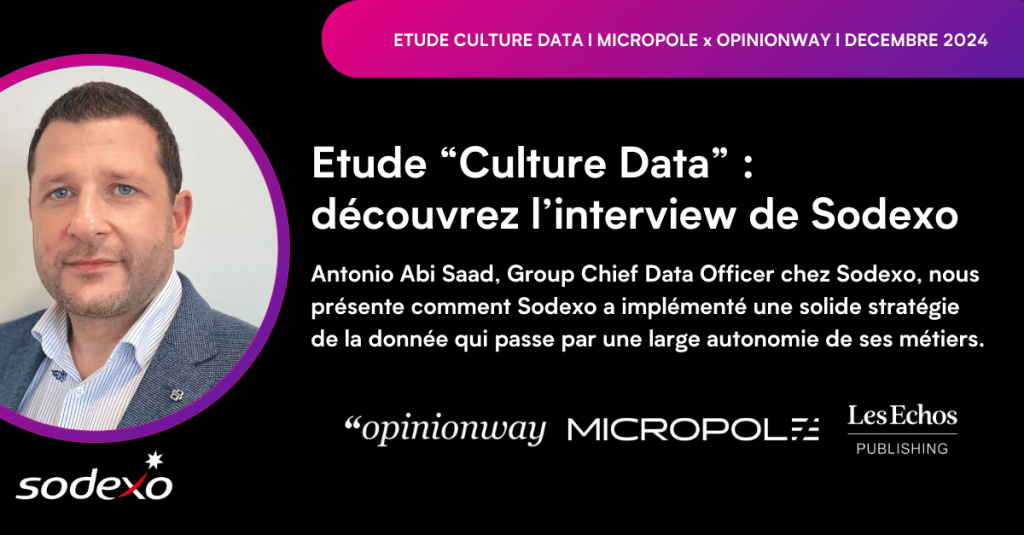
"We need to be able to deliver our Data services on a global scale. So we want to establish common working methods around data."
In this exclusive interview, Antonio Abi Saad stresses that the management and use of data cannot be effective without close collaboration between the different functions of the company. At Sodexo, this vision translates into collaborative governance, where each business plays a key role in defining and exploiting data. Thanks to a "data-as-a-product" approach, teams benefit from a global framework while retaining local autonomy, enabling them to address the specific needs of different regions and activities.
Sodexo not only centralizes its data, but ensures that it is used strategically to improve service quality, optimize operations and meet objectives such as reducing waste or adapting to consumer expectations. By putting Data at the heart of its businesses, the Group reinforces the adoption of data-driven practices and fosters continuous innovation across all its regions.
Watch the interview with Antonio Abi Saad below and download the white paper by clicking here. It presents the results of the study and reveals 10 interviews with leading experts.

Can you tell us about the Sodexo Group?
Antonio Abi Saad: "Today, Sodexo is the world leader in sustainable food and quality experiences. We accompany our clients and consumers at every stage of their lives, as we are present in schools, high schools, universities, workplaces and leisure facilities, as well as in hospitals and senior citizen facilities. "
Why is Data essential to your business?
"Data is omnipresent at Sodexo. It can be generated by consumers, via our applications, via connected objects, but also by our suppliers and partners. It is strategic to better understand our customers but also to adapt to their tastes, frequencies and consumption trends.
It's important for us to be able to deliver our data services on a global scale, because that's where our customers are. So we want to establish common working methods around data.
In 2017, we initiated our first artificial intelligence experiments, created a data lake and began industrializing the first BI and AI products. In 2021, an acceleration plan was launched to harmonize working methods and deploy key functionalities of our platform at scale. The arrival of our Group Chief Tech, Data & Digital Officer on the Executive Committee in 2023 strengthened our commitment to technology, digital and data, also enabling the validation of the "Data Centric" program. This program aims to transform our platform into a true data hub, ensuring data consistency and availability. We have identified three major challenges: building a common language, standardizing communications via APIsation of systems, and data quality. "
What is your mission in this context?
"As Group Chief Data Officer, my main missions are data management and the deployment of a data platform, called Data Hub. My role is to define and implement data governance policies, while ensuring their compliance and effectiveness. I put in place a global framework that empowers the business units by offering them maximum autonomy.
I also have to adapt these policies to the specific needs of our different regions and the services we deliver, as we operate in many countries in Europe, Asia, Latin America and North America.
The Data Hub, deployed in our four main regions, aims to provide high-quality services for our customers on a global scale, while taking into account local specificities. It ensures communication between systems, and the storage, analysis and exploitation of data, using a common language for greater consistency. "

Data is strategic to better understand our customers but also to adapt to their tastes, frequencies and consumption trends.
Is your organization highly centralized?
"We're more into collaborative governance. We operate as a network, with a Data Manager for each major business area. Each area manages its key data as a product in its own right; we speak of "data-as-a-product" with a dedicated team and specific governance. This approach ensures efficient data management, enhanced traceability and a continuous quality improvement action plan for each domain.
Data is centralized on our "Data Hub" platform, facilitating access and use by different applications and systems. This principle favors regional autonomy and the use of standardized methods and a common language, which currently covers over 50% of prioritized data.
Some areas are more mature than others. For example, the Purchasing domain is mature and applies this "data-as-a-product" vision end-to-end, including the management of IT activities prioritized by business value. Another indicator of maturity is that the Purchasing domain applies this "data-as-a-product" vision with common data definitions, not only for analytical and digital needs, but also for transactional systems.
At local level, some countries have data managers who respond to country-specific needs, such as the integration of personnel management data or the creation of specific monitoring dashboards. These key players guarantee the quality of the data in the source applications and ensure the link with Group requirements such as compliance with personal data protection policies. "
In practical terms, how do you support them?
"We organize weekly committees with domain managers and very regular meetings with local managers. This enables us to pass on to Group level any local initiatives that could be generalized.
Our role is to provide tools to help this community of data users to share and use information effectively on a daily basis. For example, we have created a data catalog portal that enables users to consult and understand common language within the Group, such as business definitions: what is a point of sale for Sodexo; what is a brand; what is a recipe, etc.?
We have also set up a Data Marketplace to facilitate access to data centralized in the Data Hub. In just a few clicks, for example, Finance teams can identify the data available from Purchasing and request access, justifying their need.
The CSRD is a good illustration of the importance of this type of approach. This directive requires effective coordination between the company's various stakeholders, regional teams, Group teams, and also the various departments, Finance, Purchasing, Food and Human Resources in particular. "
Our study shows that most managers are primarily aiming for greater operational efficiency. Do you share this desire?
"Absolutely. We need Data to continually improve our services by deepening our knowledge of customers and consumers. For example, in some regions we useeco-scoring applications that inform consumers about the carbon impact of their menu: this requires the collection and analysis of new categories of data.
But Data is also needed to optimize our costs and operational capabilities, for example to predict site traffic, plan interventions and optimize raw material supplies.
Sodexo is strongly committed to reducing food waste, and this means first and foremost measuring the amount of waste produced, and collecting and processing this data accordingly. "
This Data Culture integrates data at the heart of operations and decision-making with strong governance, easy access, training and continuous innovation, while ensuring the autonomy of domains and regions.
Employees feel they have little or no training in data: only 24% are satisfied. What does this figure tell you?
"This is a consistent percentage: last spring we carried out an online estimate showing that 25% of employees feel trained in data. It also reflects market trends.
However, the level of maturity varies considerably within our organization. All of our senior executives are trained in Digital and Data issues, enabling them to sponsor and promote these issues as part of business initiatives. We have also created communities of specialists including data scientists, data analysts, etc., at both global and local levels.
Training begins with an onboarding session to clarify roles and objectives, and ensure that everyone has mastered the necessary tools. These communities are then animated on a regular basis to federate the various players and share best practices. Finally, we make all employees aware of the use and importance of Data via short modules, helping to spread this Data-centric culture throughout the company. "
How would you define a good Data Culture?
" A good Data Culture manifests itself when decisions are made on the basis of reliable data and the use of data is democratized, making it accessible to as many employees as possible. Employees must understand the importance of quality data, be trained and made aware of how to use it, and be able to take full advantage of it to optimize their performance and improve the company's results.
This culture integrates data at the heart of operations and decisions with strong governance, easy access, training and continuous innovation, while ensuring domain and regional autonomy. "
About the Culture Data study
TheCulture Data study, carried out by OpinionWay for Micropole, explores how companies integrate data into their strategic and operational processes, and identifies gaps between the vision of managers and the reality experienced by employees.
Digital transformation has repositioned data management at the heart of companies' strategic challenges. However, implementing a true Data Culture remains a complex challenge. We set out to understand how companies can overcome technological, organizational and human obstacles to create an effective and sustainable use of data.
In this study, you'll find trends as well as feedback from 10 leading experts on data transformation within their organizations:








Find out more about the study in the white paper
- An infographic revealing the key findings of the study
- 10 inspiring interviews with top-flight speakers
- Tips for transforming your organization by putting data at the heart of your decision-making process
- Keys to Data acculturation