Discover the Vision of Audrey Thum, Director of Sustainable Development at FM Logistic
Micropole has unveiled its study on Data Culture, "Stratégie Data: de la vision à l'engagement collectif", carried out with OpinionWay. The study underlines the importance of data as a driver of transformation, particularly in achieving strategic objectives such as optimizing operations or reducing environmental impact. However, structuring and using data effectively remains a challenge for many companies.
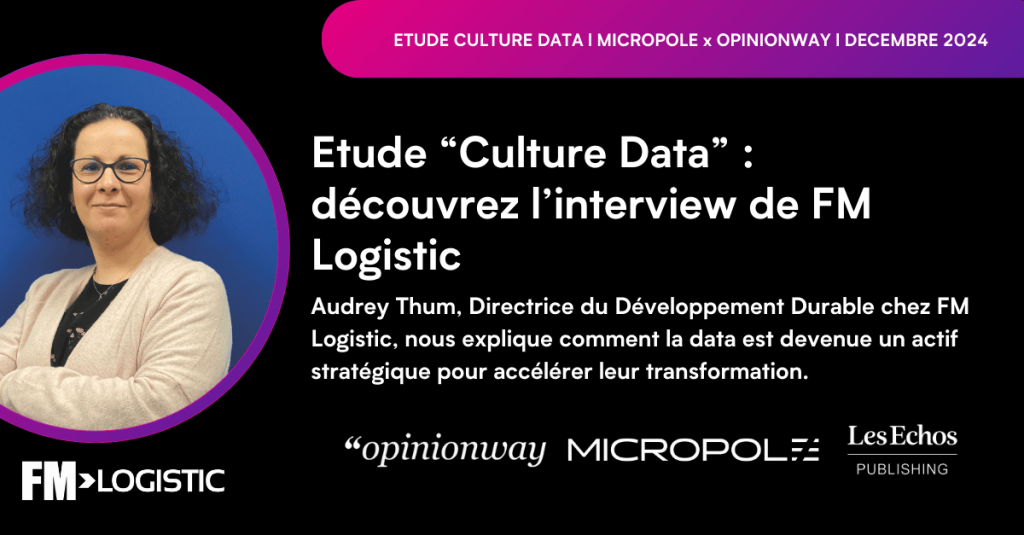
Audrey Thum, Director of Sustainable Development at FM Logistic, shares how the group uses data to achieve strategic objectives such as reducing workplace accidents and improving environmental impact. Thanks to close collaboration between data producers and data users, FM Logistic is building a Data Culture at the service of the company's positive transformation.
"Our main objectives are to improve the safety and well-being of our employees, and to reduce the impact of our activity on the environment".
For Audrey Thum, data is a real catalyst for transformation when used in a targeted and structured way. At FM Logistic, it's not a question of accumulating data, but of prioritizing it and translating it into simple, actionable indicators. This streamlining eliminates unnecessary complexity and allows us to focus on what generates real impact, such as reducing accidents or improving environmental performance.
The chosen approach is based on collaboration and contributes to transforming data into a strategic tool serving the Group's objectives, whether to reduce accidentology, optimize transport flows or meet regulatory requirements. By bringing data producers and users together around a common base, FM Logistic is strengthening its ability to achieve its ambitions in terms of sustainable development and performance.
Watch the interview with Audrey Thum below and download the white paper by clicking here. It presents the results of the study and reveals 10 interviews with leading experts.

What are your goals around employee well-being, and how does Data help you achieve them?
Audrey Thum: "We began by addressing the issue of accidentology, which is central to our business. We're aiming for 'zero serious accidents' by 2030. On this subject, we had no shortage of data: dates, frequencies, severity, and so on. But while we had a good data collection system, we lacked a structured vision. The challenge was therefore to put in place a small number of reliable key indicators that would enable us to steer our strategy. "
What measures have you put in place to achieve this?
"First, we asked ourselves the right questions: what do we want to measure? For what purpose? Do we have all the right data? If not, who is capable of producing them?
In terms of accidentology, data tends to come from the HR and Legal departments, but it's mainly the QHSE (Quality, Health, Safety and Environment department) and field managers who need it to make decisions, particularly in terms of prevention. Those who produce the data and those who use it are not the same people. We brought them together around the QHSE, who was the group owner of these committees. "
According to our survey, 58% of managers think it's difficult to encourage employees to use data. Do you share this view?
"I wouldn't have given you the same answer two or three years ago. The point is to make people understand thatwe need to "de-silo" in order to have a global and effective vision.
Our ability to collect data did not initially serve the analysis, but on the contrary led to the multiplication of sometimes complex indicators that did not allow for a clear and simplified vision. It was therefore necessary to have a common base, and we had to explain that this necessity would lead to the abandonment of certain specificities. Because everyone has the impression that they need specific data, different from that of others. To facilitate this change, we involved our teams in the process of defining key markers that would enable us to determine whether our company was in "good health" in terms of accidentology. "
Our survey shows that 54% of executives cite the tool as their main Data initiative. Have you invested in any particular technology?
"What's essential is to have the same reading keys. A few years ago, we switched all our tools over to the Google suite, and this made it easier to use the data.
ISD employees are responsible for setting up Lookers (a data visualization data visualization and connect data from different databases. Looker enables data visualization of very heterogeneous data, and it's easy to modify and adjust the tool according to user feedback. Users can easily produce and share analyses. "
Only 29% of employees claim to be trained in Data. Have you set up specific training programs?
"Indeed, we trained all employees who wanted to be trained in the Looker tool, and they became ambassadors for Data Culture in their departments.
Our aim was for our employees to be autonomous, so that their knowledge of the tool's possibilities and limitations would enable them to make proposals and accept arbitration more readily. You don't get people on board by simply asking for their opinion, but by really involving them.

Data Culture is the ability to connect everyone - those who produce data and those who will use it - around a common base, using simple tools to achieve specific objectives.
The implementation of the CSRD directive is the main task facing sustainable development managers, and the issue of data is central to this. Do you apply the same principles as in accidentology to prepare for this?
"We're not starting from scratch: our company has been committed to ISO certification for many years, and thus to continuous monitoring and improvement processes. For a long time, we measured energy consumption on the one hand, waste volume on the other... this time, we're required to take a consolidated view.
To answer your question, we do indeed follow the same principles, first and foremost that of rationalizing our Data approach. Let's take the example of water, which is not a key resource for our company, and therefore does not represent a challenge in terms of improving our environmental impact. We have decided to produce just one indicator, which is our overall consumption in France, because there's no point in going into complex levels of detail that won't bring about significant change. For each subject, we need to ask ourselves what indicators we want to track. "
Applying this directive also means working with your partners. How do you involve them in your approach?
"The carbon audit had already led us to work on scope 3, and therefore to collect certain data from our subcontractors, such as the number of kilometers covered. The CSRD has led us to multiply the amount of data we need to collect and the number of contacts we need to involve , in a context where most of our transport activity is subcontracted.
We're now in the phase where we're trying to identify the missing data, which is a major undertaking. Even if most of the work is done in France, the new regulatory situation means that we have to collect data in all the countries where we operate. Even if all our subsidiaries work with the same tools, data collection can be very different because legislation is not the same everywhere.
In addition, a consultancy helps us define our indicators and make choices. For example, like other players in our sector, we are not going to track the impact we would have on the oceans, because, as we are not involved in shipping, this impact is totally indirect. "
Do you think this directive will speed up the implementation of a Data Culture in corporate CSR?
"The evolution of the regulatory corpus imposes on us (and this was already somewhat the case with the carbon footprint), but also enables us to have more concrete and documented sustainable development policies. In the past, some companies have been able to post far-reaching ambitions without really measuring what this implied in operational terms. In this case, we need to establish real guidelines and ways of achieving our objectives.
To reduce the emissions defined in scope 3, we need, for example, to further develop multimodal transport, optimize transport flows and truck filling. This requires in-depth analysis of a wide range of data. Data culture has therefore become essential for managers like me. But it doesn't mean you have to be an expert in all data - and that's absolutely impossible. Data Culture is the ability to connect everyone, those who produce the data and those who will use it, around a common base via simple tools and in the service of precise objectives. "
About the Culture Data study
TheCulture Data study, carried out by OpinionWay for Micropole, explores how companies integrate data into their strategic and operational processes, and identifies gaps between the vision of managers and the reality experienced by employees.
Digital transformation has repositioned data management at the heart of companies' strategic challenges. However, implementing a true Data Culture remains a complex challenge. We set out to understand how companies can overcome technological, organizational and human obstacles to create an effective and sustainable use of data.
In this study, you'll find trends as well as feedback from 10 leading experts on data transformation within their organizations:










Find out more about the study in the white paper
- An infographic revealing the key findings of the study
- 10 inspiring interviews with top-flight experts
- Tips for transforming your organization by putting data at the heart of your decision-making process
- Keys to Data acculturation