The view of Luc Barnaud, Chief IA & Data Officer
of Groupe BPCE
In its study "Stratégie Data: de la vision à l'engagement collectif", carried out with OpinionWay, Micropole highlights the importance of structuring data strategies around concrete business needs to maximize their impact. The study reveals that Data adoption remains a challenge, particularly in decentralized organizations.
On the occasion of this study, Luc Barnaud, Chief IA & Data Officer of the BCPE Group, France's second-largest banking group with its Banque Populaire and Caisse d'Epargne networks, was interviewed to share his vision and feedback on the importance of federating employees' data skills in order to support their skills development.
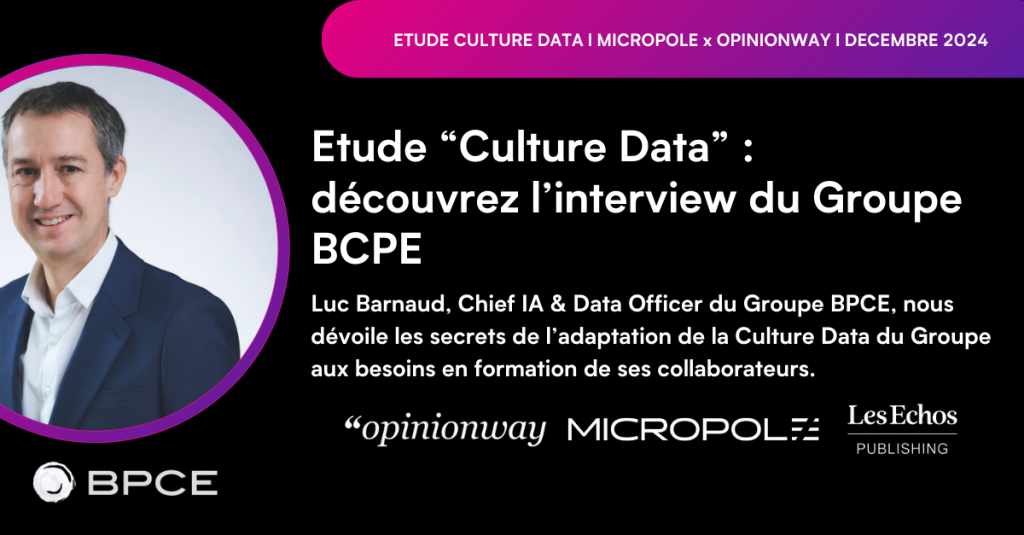
"Data acculturation requires practical support and decentralized governance".
The subject of data acculturation is a priority for the BCPE Group. In this interview, Luc Barnaud presents the resources deployed by the Group to federate data skills within its various business lines, notably by creating a network of 50 data managers to support employees' skills development. He also emphasizes that training must be targeted and in line with the specific needs of each profile within the organization. He also stresses the importance of Data Culture, not only to maximize the use of data, but also to guarantee its quality and effectiveness in strategic decision-making.
Watch the interview with Luc Barnaud below, and download the white paper by clicking here : so you don't miss out on any of the study's findings and 10 interviews with top experts.

How is Data transforming the banking profession?
Luc Barnaud: "Data has always been an inherent part of our business: even before IT existed, we kept account books. But until a few years ago, Data was used as part of the business processes of each of our professions, without any cross-functional vision at company level. The creation of a dedicated AI & Data department raised awareness of the intrinsic value of data to encourage more sophisticated uses. To do this, we had to choose common tools and facilitate data sharing. "Desiloting" the data approach was also favored by regulatory requirements, which necessitated this cross-functional vision. "
What challenges does this harmonization address?
" This cross-functional approach to data serves the performance of our businesses and the satisfaction of our customers. For example, in marketing, we have enriched our "product" vision with a "customer-centric" approach. "customer-centric" approachusing both financial and extra-financial data. The idea was to identify customers' life stages (first permanent job, retirement, etc.) to better qualify our advice and personalize our relationship with them. For Banques Populaires and Caisses d'Epargne, this represented a real marketing shift.
The fraud detection is another major challenge: we handle 11 billion transactions every year, and must protect our customers. However, fraudsters are becoming increasingly creative, and it is imperative to cross-reference data from several of our fields - and therefore from different information systems - to be able to spot weak signals and have a statistical approach to the probability of fraud.
Finally, the digitization of paper documents - still widely used, especially in branches - is an operational efficiency issue for our advisors, and a Data challenge insofar as it involves unstructured data. "
What kind of governance have you put in place?
"At the center of our system is the business: it's the decision-maker who commits budgets and determines the roadmap. Around him, the AI & Data experts and the IT Department are at the service of performance and simplification. Together, we hold monthly meetings and decide on priorities.
This governance is fundamental, it's not an administrative detail: it ensures that investments are perfectly in line with the business priorities of the professions, and that we will follow through to the end of the execution, monitor the KPIs and give ourselves the opportunity to industrialize what works. Of course, as I'm in charge of Data at Group level, I'm a driving force behind proposals and innovation, but we're in a logic where it's the establishments and business lines that drive the ambition for transition. "
This presupposes a data skills base within the business lines. Do you have any decentralized experts reporting to you?
"We have set up a network of around fifty data managers, and have invested heavily in their training. With the help of the Ecole Polytechnique, we have created a dedicated high-level diploma course for these Data Managers. They form the backbone of our organization , and work in the Banques Populaires and Caisses d'Epargne, as well as in Groupe BPCE's business lines. They lead local strategic committees and oversee the organization: how is Data governed and put to quality? Are tools standardized? What are the uses of AI? We bring these data managers together virtually every two weeks, and work with them in a spirit of co-construction.
They are not simply spokespersons for the "central management" of IA & Data. They are fully involved in and contribute to the Group's approach and, as they report to their CEO, they are responsible for steering and executing the roadmap for their establishment. Our response to a decentralized organization in which data sharing was impossible was not to recentralize, but to federate. "
The study we carried out with OpinionWay shows that data training is very much concentrated on top management and high-level executives. What is your approach?
"To define our training strategy, we've created "personas": whether you're an executive, a manager, an expert (data engineer, data scientists, etc.) or a business user, your training path won't be the same within our Data and AI Academy. We manage it like a product. Over 20,000 BPCE employees have already completed one or more modules.
I see that your study shows that 73% of employees feel they are not making optimal use of Data. This raises the question of expectations: what do we want to achieve? Who needs what skills? We need to tailor our training courses to meet these needs. If you talk to a plant manager, he'll tell you that his staff already have a huge amount of training every year, and that we can't keep adding to it indiscriminately. So our approach is to adapt to users' need for knowledge. "

We need to tailor our training courses to our needs.
Only 53% of employees claim to use Data. Aside from specific training, how do you manage the acculturation of the greatest number?
" Acculturation is fundamental. We have set up communities of users around our data visualizationin particular Power BI. We have 5,000 employees who produce applications using this tool, and 50,000 who will use it to consume data.
But it's not enough to source and reference external solutions to get people involved . That's why, for example, we have appointed a product owner for Power BI. We have rituals, organize regular events, and our internal social network even helps to animate this community.
We also raise awareness of the importance of data quality. Poorly informed data can cause considerable damage. It's crucial to describe data well in order to analyze it properly and facilitate decision-making. This is even more true with the deployment of AI, whose success depends on good data quality. Moreover, the deployment of AI within organizations requires even greater HR involvement and an ambitious training policy, as the question of employee skills is more decisive here than technological aspects. "
The question of employee skills is more decisive than technological aspects.
What do you think defines a good Data Culture within a company?
"Firstly, awareness of the intrinsic value of Data: it's not just a cog in the wheel in processes, but holds real potential for opportunity. Secondly, it's essential to ensure that the way in which data strategy is deployed corresponds to the business vision. This is the sine qua non for widespread use. Last but not least, it must be simple and satisfying for employees.
To move forward, we also need to measure our efforts: we have set up data maturity diagnostics, which enable us to assess practices, the level of standardization of tools, employee acculturation and processes to ensure data quality. This enables us to target the improvements that need to be made, and to support each individual according to his or her needs and level. "
About the Culture Data study
TheCulture Data study, carried out by OpinionWay for Micropole, explores how companies integrate data into their strategic and operational processes, and identifies gaps between the vision of managers and the reality experienced by employees.
Digital transformation has repositioned data management at the heart of companies' strategic challenges. However, implementing a true Data Culture remains a complex challenge. We set out to understand how companies can overcome technological, organizational and human obstacles to create an effective and sustainable use of data.
In this study, you'll find trends as well as feedback from 10 leading experts on data transformation within their organizations:










Find out more about the study in the white paper
- An infographic revealing the key findings of the study
- 10 inspiring interviews with top-flight experts
- Tips for transforming your organization by putting data at the heart of your decision-making process
- Keys to Data acculturation