Discover the Vision of Stéphane Dehlinger, Global Learning Director at Pernod Ricard
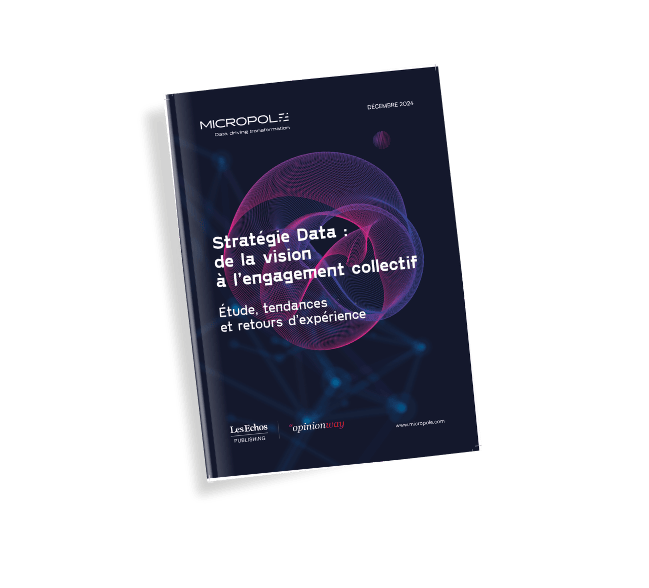
Micropole has unveiled its Data Culture survey "Stratégie Data: de la vision à l'engagement collectif", carried out with OpinionWay. It shows that training is the most important action to develop the use of Data, as defined by the managers and employees interviewed for the study. For the majority of them, democratizing use is a complex task.
Stéphane Dehlinger, Global Learning Director at Pernod Ricard, talks us through the Group's training strategy to strengthen employee skills in Data and Artificial Intelligence (AI).

"At Pernod Ricard, data skills are defined in conjunction with the business lines.
In this exclusive interview, Stéphane Dehlinger stresses thatdata acculturation cannot be achieved in isolation, but must be co-constructed with the company's various functions. In this way, data skills are defined in collaboration with the business functions, to meet the specific needs and challenges of each department. The aim is to make every employee, whether in marketing, production, finance or sales, capable of understanding, interpreting and using data strategically.
This collaborative approach enables Pernod Ricard to ensure that training courses are not just technical but also adapted to the realities of the business, enabling better adoption of Data and AI in everyday working life.
Watch the interview with Stéphane Dehlinger below and download the white paper by clicking here. It presents the results of the study and reveals 10 interviews with leading experts.

How do you design training courses dedicated to Data and AI?
Stéphane Dehlinger: "We work with all our business units to build the content of our employee skills development programs. The role of the HR function is to help them identify the skill needs of their teams. Those that are needed today and those that will be needed tomorrow, if we can anticipate them.
On the Learning side, we have set up academies for each profession, with a balance of specific content and content shared with other professions. Typically, issues of digitalization, data and artificial intelligence form an integral part of the design of these courses, which we review regularly to adapt to the rapid evolution of this knowledge. "
What areas did you focus on?
"We have a very pragmatic approach, very connected to the needs expressed by our markets and their level of maturity, which can vary according to geography. On the Data and AI dimension, the key digital programs, aimed at our sales and marketing forces, were among the first digital transformation tools launched internally. The idea was for these teams to make greater use of artificial intelligence to optimize their decision-making. This has enabled them toenrich their action plans: where they used to operate intuitively, relying essentially on their experience, they are now able to guide their choices in the light of new clues. They can now, for example, optimize salespeople's visit circuits or the promotion rates we apply, based on enriched data.
In parallel with these targeted business actions, we supported these marketing and sales teams by acculturating them to data analysis via an internal certification program called D-Passport, so that they could make the most of the potential of these tools. The aim was to anchor skills, enable them to share a common language and fully understand the company's approach to Data and AI, with a mandatory program for these teams. D-Passport 's first season predates COVID. Since then, it has been followed by other seasons and extended to other employee groups. "

To accelerate our digital transformation, we have systematically combined our traditional in-house business skills with expertise that we have sourced externally and brought in-house.
According to the Data Culture survey we conducted with OpinionWay, 58% of managers believe it's complex to raise employee awareness of Data.
Aave you encountered any resistance during these training sessions?
"Still based on this principle of pragmatism, we generally start by experimenting in markets that are willing, and build on pilots with promising results to generate curiosity in other markets that are initially less mature about Data or less receptive to change.
If, on the margins, a managerial hurdle around the issue of the time devoted to these training courses can appear, our organizational model helps us to make the appropriation process very gradual. By starting on a small scale, we act in an agile manner, before managing a transition to a larger scale, integrating the associated change management dimension. The Data and AI teams, with their dedicated deployment teams, enable this flexibility, with the support of our IT teams who focus on the infrastructure and evolution of our information systems. To accelerate our digital transformation, we have systematically combined our historic in-house business skills with expertise that we have sourced externally and brought in-house. For example, by recruiting data scientists, data engineers or data stewards, who have enabled us to acquire a real Data Culture within our operational functions. "
Again according to the study we conducted with OpinionWay, 76% of employees consider their training to be inadequate and their use of Data less than optimal.
"This sentiment is probably a sign of a growing appetite among employees to better understand the implications of AI in their daily lives and how Data will change the way they work. At Pernod Ricard, we're trying to respond to this thirst for learning by offering a multi-level reading.
In addition to D-passport , which we mentioned earlier, we have set up a system called Platform Pioneers, which aims to open up the perspectives of our leaders on the issue of Data and to make them ambassadors to their own teams, in particular to avoid the obstacles to training that we mentioned earlier. 350 people have been continuously trained in this way for over 2 years, and we are seeing our leaders take up the subject with an operational transposition of the potential of AI.
These discussions are now helping us to work on another layer of content: the preparation of use cases by major professions. Following in the footsteps of marketing and sales teams, new academies are now integrating the AI dimension: supply chain teams, for example, will soon be supported in this change, for obvious reasons of supply chain transformation linked to the challenges of reducing environmental impact and optimizing costs.
We don't want to leave anyone by the wayside, especially as the emergence of artificial intelligence has made this a professional as well as a societal issue.
What have you put in place for more occasional and less expert users?
"Your study poses the essential question of acculturation: how to make as many people as possible aware of the importance of Data and put in place the level of skills needed by everyone. We don't want to leave anyone by the wayside, especially as the emergence of artificial intelligence has made this a professional as well as a societal issue.
Our training challenge today is to determine the right use cases, always with the aim of being highly pragmatic and serving the businesses. It's an ambitious undertaking, involving some 12,000 employees. We've started by setting up several webinars that can be supplemented by individual sessions, between an employee who would like to know more and a data or AI expert. Around 1,500 people have attended at least one of the 35 webinars organized to date and delivered entirely by our in-house experts, with a view to increasing the Group's ownership of the subject of AI.
To help spread this Data and AI culture, we have recruited a network of 400 champions: volunteer employees who have shown a deeper interest, being ambassadors to teams locally and on a daily basis. Their greatest asset is proximity. They encourage appropriation of the tools and are also there to help us identify needs or use cases that we could develop.
Not everything can come from management alone. Our role is also to stimulate curiosity, to raise awareness of the challenges and opportunities of these technologies, to encourage vocations. Ultimately, our aim is to enable our teams to become creative in these areas. "
About the Culture Data study
TheCulture Data study, carried out by OpinionWay for Micropole, explores how companies integrate data into their strategic and operational processes, and identifies gaps between the vision of managers and the reality experienced by employees.
Digital transformation has repositioned data management at the heart of companies' strategic challenges. However, implementing a true Data Culture remains a complex challenge. We set out to understand how companies can overcome technological, organizational and human obstacles to create an effective and sustainable use of data.
In this study, you'll find trends as well as feedback from 10 leading experts on data transformation within their organizations:










Find out more about the study in the white paper
- An infographic revealing the key findings of the study
- 10 inspiring interviews with top-flight experts
- Tips for transforming your organization by putting data at the heart of your decision-making process
- Keys to Data acculturation