Our discussion with Arthur Dénouveaux, Chief of Staff to the Managing Director of Insurance France at Covéa.
In its study "Stratégie Data: de la vision à l'engagement collectif", carried out in collaboration with OpinionWay, Micropole highlights the importance of adapting training and organizational approaches to the specific needs of employees in order to successfully integrate Data within companies. The study shows that many business leaders face the same challenge: democratize the use of data within their teams, particularly in terms of building skills and managing the necessary tools.
We invite you to discover the vision and experience ofArthur Dénouveaux, Chief of Staff to the General Manager of Insurance France at Covéa, interviewed for this study.
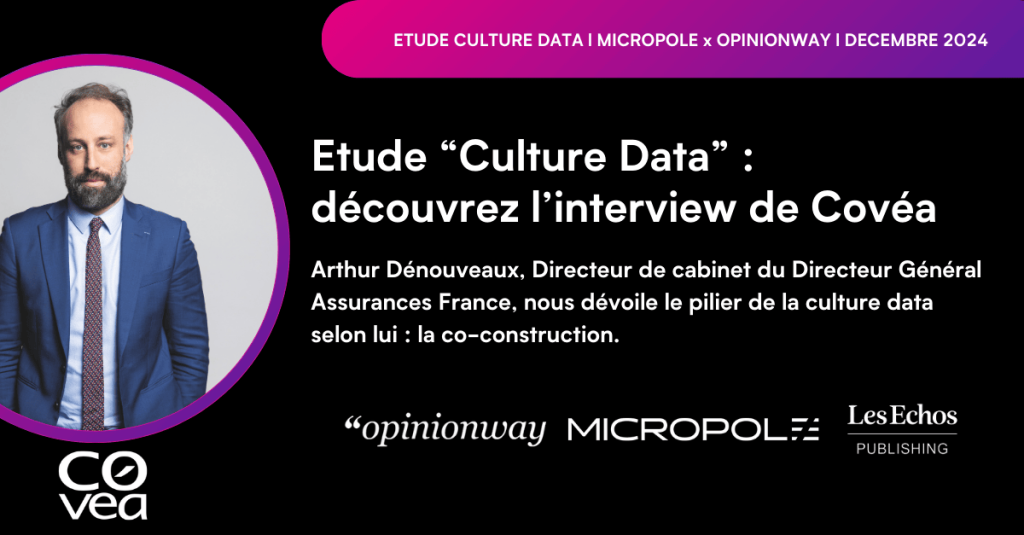
"Implementing a Data Culture presupposes a logic of co-construction between business lines and data and AI experts."
In this interview, Arthur Dénouveaux reveals the initiatives put in place by the Covéa Group to integrate data culture into its various brands, such as MAAF, MMA and GMF. He stresses the importance ofa collaborative approach, in which co-construction between business lines and experts in data and artificial intelligence plays a key role.
In his account of the strategy deployed, he points to the need to identify the specific needs of each department in order to guarantee effective and lasting adoption of data tools. In his view, data acculturation, far from being limited to tools, is in fact based on a gradual, tailored skills build-up, through targeted training modules, webinars and days dedicated to AI and Data, enabling the data culture to be federated and truly anchored within the company.
Watch the interview with Arthur Dénouveaux below, and download the white paper by clicking here : featuring the results of the study and 10 interviews with leading experts.

How do you prioritize Data-related issues at Covéa?
Arthur Dénouveaux: "At Covéa, Data is steered by the "Offers and Services" CEO , who has close links with the business lines; the data comes mainly from our brands. IT is responsible for the digital and artificial intelligence foundations. So there are data owners within the business lines, and the Group's data managers are tasked with drawing up a global map of uses and needs.
We draw up the roadmap with the brands and the various General Departments , in a spirit of co-construction. Our Group is multi-brand, so this philosophy is matrix-based. My role is to ensure that exchanges between these different departments run smoothly, and to act as a trusted third party to avoid any misalignment between the technicians and the business units. "
What is your overall approach to Data?
"Centralization is low for historical uses, but for more recent subjects, such as the dematerialization of documents, we approach it globally for the Group's three brands. One of the global challenges is to create a more sophisticated use of data , and our priority is to gain a better understanding of our 11 million customers.
In terms of use cases, our approach is based on long preliminary studies; we don't multiply proofs of concept. This is generally true of mass-market companies: given the amount of information we process, our logic is necessarily industrial. Finally, our technical constraints mean that we have to think carefully about the interdependencies and consequences of all our deployments. "
In our survey, most executives cited operational efficiency as the primary objective of strategy, far ahead of decision-making or data innovation. Do you agree?
"Yes, our main focus is on saving time for our employees and our customers. Our aim is to make data accessible and digestible in real time, because this ultimately benefits our customers. For example, we have improved the files available to our Legal Protection advisors: they are the ones who answer calls from customers complaining, for example, about a craftsman who is failing, and who need to know what recourse is available. We've created a complete database, offering immediate, tailored responses, and constantly improved by these same advisors, who judge the quality of the proposed solution.
On a more forward-looking level, we use Data and AI for predictive analysis. I myself head up a unit that leads reflection and defines strategy around AI. For example, we have an extremely accurate hail forecasting system, which is a variation based on weather models.
Our "Major Risks" division works on major climatic risks, such as storms and drought, using proprietary data, external data or synthetic data artificially created from scenarios. They enable extrapolation, as some storms only occur every 500 years, and historical data is not sufficient to model the disaster. For example, our scientists and data experts need to be able to work on the consequences of a storm Martin (in 1999) that would have started 100 kms further north or south. "

The quest for operational excellence is the key focus.
Does the data strategy benefit from significant sponsorship from the COMEX on which you sit?
" The search foroperational excellence is our main focus. One of our particularities is to manage tools based on obsolescence. The integration of Data or AI layers therefore follows the evolution cycle of these tools. In my opinion, this is a good way of doing things, even if it can lead to differences in pace between the Group's different brands.
We have a real policy of investing in sophisticated uses of data, but we're not in a permanent revolution. The insurance industry has seen other technological irruptions, such as the widespread use of the telephone some forty years ago, which was supposed to put an end to the physical agency model, whereas in the end the two coexist together in a surprisingly stable way. "
58% of managers consider it complicated to encourage employees to adopt Data. Paradoxically, training is mainly aimed at managers, and even top managers. How do you manage employee skills development?
" The human question is the biggest topic and this response rate doesn't surprise me. At Covéa, the human resources department has created a training stream around Data and AI and this enables us to gauge business needs well.
Our approach is based on five pillars: enlighten, accompany, animate, federate and anchor. There are awareness-raising modules and a workplace where all employees can consult instructional videos on the use of data. We also organize webinars and " Data and AI Days ", which enable us to federate the brands : we present innovations to business line managers, and outside experts come in to share their knowledge. We also have more advanced training modules to "anchor" skills, and we train many data scientists and data engineers. "
Our survey shows that just 53% of employees say they use data. Where do you stand at Covéa?
"We haven't carried out this type of survey, but I think there's bound to be a difference between perception and actual practice. Almost all our employees use data. Unlike retail, we only sell our products on the basis of information, and therefore data: customer profiling, risk pricing, etc. "
Employee acculturation and skills development are the keys to successful innovation.
How would you define a good Data Culture?
"I think the most important thing is to be able to measure the right effort. It's not cost-effective to do the 'best deal' at a very high cost. Nor is the trend towards "one size fits all", where we implement the same systems for everyone. We need to understand the diversity of the issues at stake: how do we manage cold data, hot data, real-time access, etc.?
Jt's also important not to lose human skillsThis could be the result of an unreasonable use of artificial intelligence. Before investing in tools the acculturation and skills enhancement of employees are the keys to successful innovation.. "
About the Culture Data study
TheCulture Data study, carried out by OpinionWay for Micropole, explores how companies integrate data into their strategic and operational processes, and identifies gaps between the vision of managers and the reality experienced by employees.
Digital transformation has repositioned data management at the heart of companies' strategic challenges. However, implementing a true Data Culture remains a complex challenge. We set out to understand how companies can overcome technological, organizational and human obstacles to create an effective and sustainable use of data.
In this study, you'll find trends as well as feedback from 10 leading experts on data transformation within their organizations:










Find out more about the study in the white paper
- An infographic revealing the key findings of the study
- 10 inspiring interviews with top-flight experts
- Tips for transforming your organization by putting data at the heart of your decision-making process
- Keys to Data acculturation