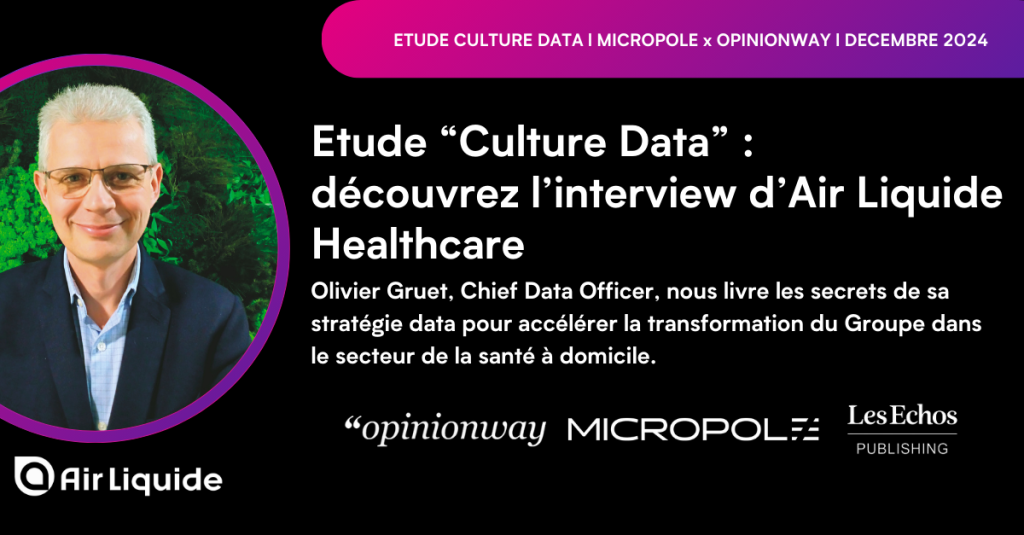
Read the interview with Olivier Gruet, Chief Data Officer at Air Liquide Healthcare
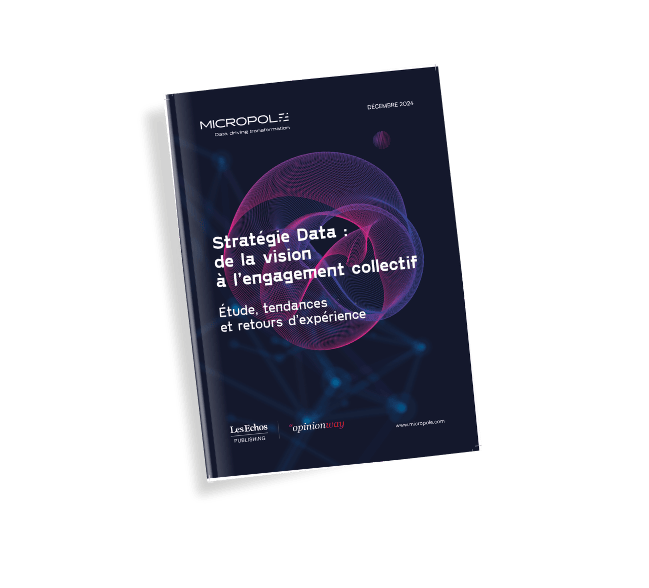
While Micropole recently published its study on Data Culture, entitled "Stratégie Data: de la vision à l'engagement collectif" and carried out in partnership with OpinionWay, we invite you to discover the exclusive interview with Air Liquide Healthcare, conducted on the occasion of this study.
The Group's Healthcare business has implemented a value-based healthcare approach to accelerate its transformation in the homecare sector.
Air Liquide Healthcare, represented by Olivier Gruet, the Group's Chief Data Officer, shares with us the method deployed by the Group to accelerate its transformation in this sector, as well as the broad outlines of its operating model, which is based on an innovative approach geared towards personalized care, made possible by optimal data management.
"Personalized support requires perfect organization of Data".
In this interview, Olivier Gruet highlights the importance of a collaborative approach to defining data skills. He emphasizes that personalized care, at the heart of business transformation in the homecare sector, relies on optimal data management.
To achieve this, Air Liquide Healthcare has set up a rigorous method of data collection and analysis in conjunction with the various departments, to meet the specific needs of each business. This approach enables every employee, whether in the medical sector, data management or logistics, to understand and use data to improve care paths and patients' quality of life.
In this way, Air Liquide Healthcare ensures that the use of Data is not only technical but also deeply rooted in the realities of each function, in order to maximize its effectiveness in the Group's digital transformation.
Watch the interview with Olivier Gruet below, and download the white paper, which presents the results of the study and 10 interviews with leading experts, by clicking here.

Personalized treatment is one of the main challenges facing homecare. What data do you use to define the kind of support that's right for each individual?
Olivier Gruet: "We wanted to develop personalized support for two million people living with sleep apnea, diabetes or another chronic pathology. This approach requires perfect organization of the Data: we need to collect, with the patient's consent, information from the devices as well as their medical data and other data from questionnaires that will enable us to understand how the patient experiences the treatment and their expectations in terms of quality of life.
The first challenge was to define the data we wanted, standardize this definition and finally speak the same language around data. We have subsidiaries in some thirty countries, some of which have different information systems. So we created a business-oriented core data model, which enables us to describe all our data in a single language, whether for a patient or for a support plan. We asked all our subsidiaries to use this model in order to collect high-quality, harmonized data, and to produce the same indicators.
Added to this is a significant regulatory dimension. New standards, often enacted on a global scale, aim to harmonize medical data in order to facilitate exchanges. For example, we have integrated the standards in force within the European Health Data Space into our data model. While the IT Department's modeling teams took care of this highly technical part, the Legal department and the Data Protection Officer were also involved, as the production and distribution of medical data are extremely regulated."

We need strong sponsorship from top management, without which transformation is impossible.
What method did you use to achieve such a result?
"First of all, you need strong sponsorship from top management, without which transformation is impossible. We're fortunate to have full support in this area, as our company already has a data culture firmly rooted in other activities.
Next, we need to understand needs and define use cases. We have a highly structured approach based on value-based healthcare : improving the patient's quality of life at the lowest cost to the healthcare system is at the heart of our organization of home healthcare services.
I therefore carried out extensive identification and prioritization work with the business units. The risk would have been to multiply time-consuming and ineffective proofs of concept. You can't simply create a dashboard or deploy an algorithm to see what happens. You need to measure the long-term value of what you want to initiate, and have a clear idea of the expected results. All this requires appropriate governance, a structured methodology and the mobilization of the right skills to move forward."
You share questionnaires with patients to optimize this personalized support. How do you ensure data quality?
"Even though we digitize some of these questionnaires via apps, for elderly patients, our technicians and nurses ask the questions over the phone or at home. There is a great deal of preparation on how to conduct the questionnaire by our teams to produce reliable information on the patient's experience of their treatment and their expectations. These can vary enormously: a person with sleep apnea may fear losing his job because he nods off, or falling asleep at the wheel, or worrying that his snoring will get in the way of his marriage. Whatever they are, we need to take their needs into account.
In addition to questionnaires, we have also set up tools that are more " gamified " and function a little like sports applications, with which the patient can test, for example, the improvement in his or her respiratory capacity, and thus also generate data. It's very important to us that patients should play an active role in their own treatment. All the data is "translated" into the core data model, then brought to the data platforms where wecan categorize the information and determine the most appropriate support plan for the patient. Our aim is to provide our operational teams and prescribing physicians with quality data to make decisions aimed at adapting treatment."
The study we conducted with OpinionWay shows that implementing a genuine data strategy encourages employee participation. Do you agree with this finding?
"Absolutely. We have put in place a strategy based on personalized care, which is only possible through optimized use of Data, and I think our employees have all understood this. We have created a data ecosystem that is fairly centralized , but from which teams can draw to produce their analysis, when a doctor or an authority has asked them for information.
From data ownersare in charge of accelerating the transformation on the ground. For my part, I ensure good governance and the sponsorship of the subsidiary's General Manager, to create the right conditions for ownership. Our aim is to roll out a successful local initiative at a controlled cost: this is where our model really comes into its own. But we are not yet at this level of maturity."
It's vital that operational staff get to grips with this transformation around Data and AI.
Managers themselves admit that training is often aimed at top management (87% cite it first) and middle management (77%). What is your training policy?
"We want to organize a much broader upskilling of our teams, not just managers, or even specialized positions of data engineers or data scientists. It' s absolutely essential that operational staff get to grips with this transformation around Data and AI.
In all our departments, we have employees who produce analyses: for management control, for market analysis and so on. They all use sophisticated Excel spreadsheets, which they are sometimes the only ones able to use. We're trying to convert them to Python, an accessible programming language that will enable them to perform more advanced data analysis.
We have therefore created an in-house training scheme called AI Readiness. One of the special features of this program, and one which is very important to me personally, is that the manager of the volunteer employee follows an associated program, as he or she will be part of the jury assessing the employee at the end of the 6-month cycle. It's a tactical approach that makes the manager realize that things are changing for the better , and encourages him or her to help us build up a large number of trained people throughout our organization. It's an important but lasting investment that will enable us to build employee loyalty."
About the Culture Data study
TheCulture Data study, carried out by OpinionWay for Micropole, explores how companies integrate data into their strategic and operational processes, and identifies gaps between the vision of managers and the reality experienced by employees.
Digital transformation has repositioned data management at the heart of companies' strategic challenges. However, implementing a true Data Culture remains a complex challenge. We set out to understand how companies can overcome technological, organizational and human obstacles to create an effective and sustainable use of data.
In this study, you'll find trends as well as feedback from 10 leading experts on data transformation within their organizations:








Find out more about the study in the white paper
- An infographic revealing the key findings of the study
- 10 inspiring interviews with top-flight experts
- Tips for transforming your organization by putting data at the heart of your decision-making process
- Keys to Data acculturation