Discover the Vision of Rafael Conde, FP&A at Christian Dior Couture US
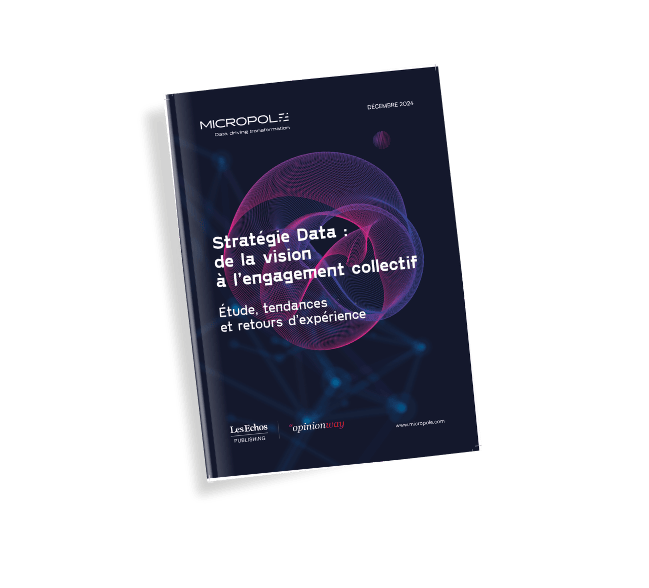
Micropole has unveiled its study on Data Culture, "Stratégie Data: de la vision à l'engagement collectif", carried out with OpinionWay. It shows that the luxury sector is particularly mature, whether in terms of the ability of its business units to place Data at the heart of their activities, in the construction and management of a committee dedicated to Data issues, or in its ability to innovate and generate sales by selling the data collected.
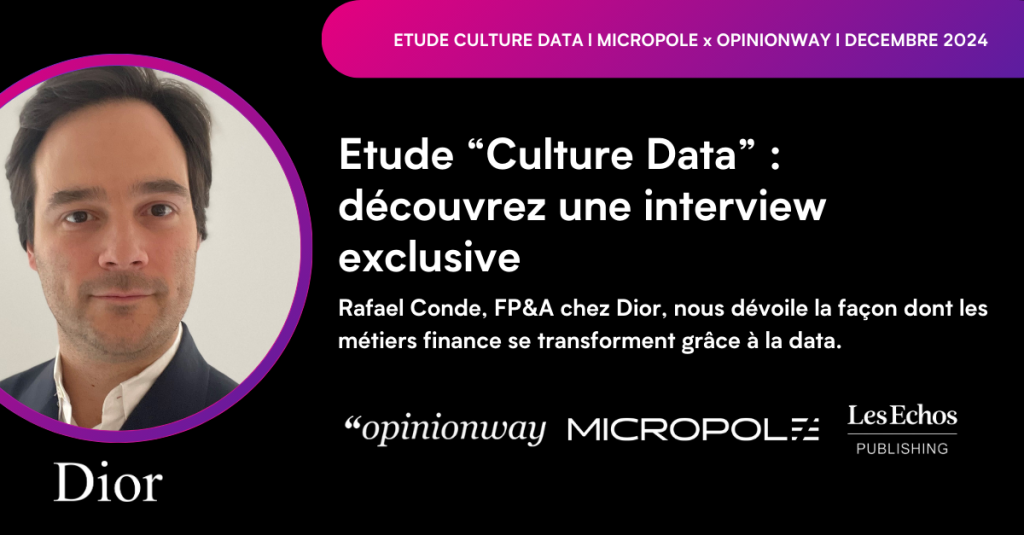
Rafael Conde, FP&A at Christian Dior Couture US, shares how data has helped strengthen collaboration between departments, optimize financial forecasting and integrate powerful tools to improve operational efficiency.
"With data, our businesses are increasingly predictive".
In this exclusive interview, Rafael Conde emphasizes that data acculturation cannot be considered in isolation, but must be co-constructed with the company's various functions. At Christian Dior Couture, data-related practices are harmonized between departments to guarantee a coherent and reliable vision, responding precisely to the specific challenges of each business.
The aim is to position finance as a strategic business partner, capable of standardizing, interpreting and adding value to data in collaboration with departments such as marketing or store management. This collaborative approach has enabled us not only to deploy high-performance tools, but also to adapt them to operational realities, thus ensuring effective adoption of data and technologies such as automation and data visualization.
Watch the interview with Rafael Conde below and download the white paper by clicking here. It presents the results of the study and reveals 10 interviews with leading experts.

Is data playing an increasingly important role in finance?
Rafael Conde: " The major challenge for finance has always been to ensure that data is reliable and consistent, in order to draw up reliable reports and enable business activity to be monitored. Today, the profession is evolving more and more towards a business partner role, especially in the United States, where these functions are now very much oriented towards forecasting and prediction, rather than a posteriori analysis.
This has led us to work more closely with other departments on data issues. For example, marketing teams enter their own data into our system, using our own parameters, so we don't have to
constantly "reconcile" our figures with theirs. If we want to determine the cost of acquiring a customer, everyone needs to speak the same language, and the data approach needs to be unified. However, a lot of information can generate different interpretations. A simple square meter of store space can be considered in many different ways (useful square meter, total square meter, etc.).
In this context, finance is increasingly the trusted third party, the arbiter who standardizes everyone else's data. This enables us to draw up detailed forecasts that are very closely aligned with reality. We have also considerably enriched and improved our analytical vision. "
Has this changed your relations with other departments?
"Yes, considerably. First of all, we had to create a climate of trust, because we have access to a lot of their data. But we also help the business units to produce analyses, and to present their projects and defend their budgets to management. Everyone is changing their practices a little to improve efficiency: the departments are getting into finance and we are fully integrating the business dimension. "
Our study conducted with OpinionWay seems to indicate a high level of data maturity in the luxury goods industry. Do you have a great deal of data expertise in your department?
"There is indeed a very mature data strategy at Dior. The challenge is not to multiply data and 'do data for data's sake'. We don't work with a logic of accumulation, but with a qualitative approach that aims to help decision-making. I don't have a data expert in my department, but we do have a good data culture.
In concrete terms, we choose data tools and solutions that are often simple and rapidly deployable, such as the creation of local databases that bring together information from different systems, to avoid juggling multiple sources. We also have our hands on data visualization tools like Power BI to create clearer, more intuitive dashboards and reports. We also automate certain repetitive tasks, via RPA (robotic process automation).
In short, we implement quick wins, which we then share if they prove effective, and we regularly exchange with head office or partners like Micropole to improve our tools and practices. "

Everyone is changing their practices for the sake of greater efficiency: departments are getting into finance a little, and we're fully integrating the business dimension.
According to the study we conducted with Opinion Way, employees feel that their use of data is not optimal. On the other hand, managers tell us that it's complicated to acculturate employees. What does this tell you?
"I'm not at all surprised. The key question is: how can we support our employees so that they embrace change? Companies have focused on tools, often made available as self-service, but employees don't know what to do with them. There's sometimes a disconnect between what's on offer and how employees see their jobs.
You have to start by asking yourself what data to analyze and for what purpose. There's a whole ideation phase to be carried out between data specialists and business line employees. To achieve this, the acculturation of the latter is key. So, employees need to be made aware of the issues and be able to share best practices.
With my team, we spend time looking at what has been done elsewhere, for example in our subsidiary in Japan, to identify what we can replicate or adapt to our local needs. "
Would you agree that, like most executives according to the results of our study, you're more in a phase where we're mainly aiming for operational efficiency in data strategies? On the other hand, do you think that AI will bring a more forward-looking dimension?
"It's all a question of maturity. Are we capable of letting go and relying on an analysis we haven't carried out ourselves? The current state of our tools doesn't allow us to make significant progress. There are still a lot of fantasies surrounding artificial intelligence. Even if you've collected good data, categorized it well and made your analysis axes clear, this doesn't mean that Generative AI is going to tell you what variations to study, or how you should look at things in a new way.
Its synthesis role is very useful for functions like mine, but in the future Generative AI will undoubtedly be a more speculative tool, imagining scenarios that we can then arbitrate and improve. "
About the Culture Data study
TheCulture Data study, carried out by OpinionWay for Micropole, explores how companies integrate data into their strategic and operational processes, and identifies gaps between the vision of managers and the reality experienced by employees.
Digital transformation has repositioned data management at the heart of companies' strategic challenges. However, implementing a true Data Culture remains a complex challenge. We set out to understand how companies can overcome technological, organizational and human obstacles to create an effective and sustainable use of data.
In this study, you'll find trends as well as feedback from 10 leading experts on data transformation within their organizations:










Find out more about the study in the white paper
- An infographic revealing the key findings of the study
- 10 inspiring interviews with top-flight experts
- Tips for transforming your organization by putting data at the heart of your decision-making process
- Keys to Data acculturation