Interview with Christophe Bonnefoux, Global Chief Data Officer at BNP Paribas Factoring
As part of its study " Stratégie Data: de la vision à l'engagement collectif" (Data strategy: from vision to collective commitment), carried out with OpinionWay, Micropole highlights the central role of training in developing the use of data within companies. The study reveals that, for many managers and employees alike, democratizing the use of data remains a major challenge.
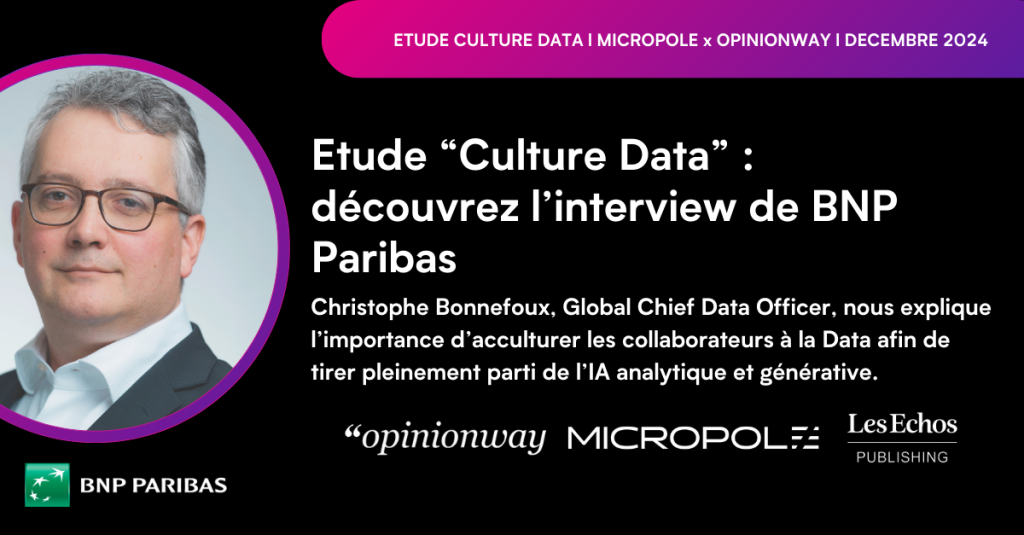
On this occasion, we interviewed Christophe Bonnefoux, Global Chief Data Officer at BNP Paribas Factoring, who shared with us his vision of data acculturation and its crucial role, in his view, within organizations.
"Data acculturation, a daily process to take full advantage of AI"
At BNP Paribas, the issue of data acculturation is taken very seriously. Throughout this interview, Christophe Bonnefoux stresses that data acculturation, far from being a one-off approach, is in fact a daily process. It's about making all employees understand the importance of data, enhancing their skills and enabling them to take full advantage of AI tools, whether analytical or generative. An investment that benefits both employees and customers, by strengthening the competitiveness and efficiency of the solutions offered by BNP Paribas Factoring.
Watch the interview with Christiphe Bonnefoux below, and download the white paper by clicking here : you'll find the results of the study, plus 10 interviews with leading experts.

Can you briefly describe the role of BNP Paribas Factoring?
Christophe Bonnefoux: "BNP Paribas Factoring is a division of the BNP Paribas Group that offers factoring and short-term financing solutions to key accounts and entrepreneurs in France and abroad. It is one of the Bank's oldest businesses. It consists of financing the short-term economy by buying invoices issued by our customers and recovering this financing requirement from their customers. So it's a business that combines financing, risk-taking and collection.Data is eminently strategic here, because we need a detailed knowledge of our customers, and our customers' customers. This data may be our own, or come from market data providers, Open Data platforms, customers themselves or credit insurers. In this context, my role is both to establish the data strategy, data governance (structured or unstructured), data quality, traceability and valuation, but also to prepare the organization for future challenges. "
What's your background?
"Since my arrival in September 2022, BNP Paribas Factoring's Data Office has been primarily involved in a Business and IT Systems Transformation Program, called the "One Factoring" Program. In particular, this Program aims to deploy a European industrial platform to satisfy our customers and pool our operational resources across the Sector.
For example, operationally, it's important that all our employees work with the same CRM tool or use the same customer and product repositories, and therefore a common language. We 'on-board' a new country on this platform every six months or so. "
What kind of governance have you put in place?
"As with Group governance, we have opted for a federated model. We operate on a territory-by-territory basis, with an approach aimed at pooling investments and resources. Certain responsibilities fall within the remit of the central team that I head, while others remain at local level when regulations so require. These issues are dealt with directly by the subsidiaries, which enjoy genuine autonomy. For example, when it comes to data protection or data quality, we operate as a network, or by community, with the data officers reporting directly to their local CEO . "
How do you work with subsidiaries on these data issues?
" Governance is fundamental. We have monthly and quarterly committees where needs are expressed. One of the Data Office's missions is to identify problems common to all the business lines, to translate these problems into data requirements, and to create the necessary conditions for deploying the same solution wherever possible: hence the need for acculturation to Data, in order to get our employees on board with the use of a new solution, a new way of doing things.
We also share local initiatives that are having a positive impact, and identify those that we can generalize and sponsor. In this respect, the autonomy of our subsidiaries and the investment of our employees are essential. We're not in the exploratory business (i.e. we don't do PoC), we focus on high value-added projects, those that can increase revenues, strengthenoperational efficiency, improve the sustainability of our solutions.
Today's technology makes it easy to go into production, which tends to increase the number of use cases. The role of a data office is therefore to challenge the business need to define it in terms of data, to model this data by business domain, to support the business in defining data access rights, and consequently to contribute to the industrialization of business projects, particularly those with the highest ROI. "

From now on, it's up to people to take back control, to internalize this knowledge, to organize its quality and thus develop the company's value.
Our Opinion Way study reveals that the majority of employees do not use data, or at least not in an optimal way. Without even mentioning analysis, data manipulation doesn't seem that obvious to them. How do you approach this question of acculturation?
"Clearly on a daily basis. Acculturation has to permeate, and we make it happen through workshops and operational committees with the business lines. At BNPP Paribas Group level, there is a specific program, notably on the regulatory aspects I mentioned earlier, but also on cybersecurity issues.
The role of my team is really to train employees in the use of simple tools, to explain data modeling or to increase the level of operationality of data governance rules which are often still too often perceived as too theoretical or too complex at first sight.
The strength of this team lies in both content and form, in the repetition and simplification of messages. Above all, this strength requires a good grasp of the business context, which is often in the throes of transformation.
It's a question of teaching, of ensuring that employees are made aware of the quality of data and its analysis. To achieve this, they need to feel they're getting something out of it. When you ask them to change the tool they've been working with for years, and you impact the business process, you have to prove the benefits of operating differently. Your study shows that communication with employees is important.
15 years ago, the market was all about Big Data, access to millions of pieces of data from which computers would magically extract extraordinary insights. Nowadays, the focus is more on frugality, which may seem paradoxical with the emergence of analytical or generative AI, which by their very nature consume a lot of data.
But the time has come for a more sober approach: what data is essential to manage a business, to win market share, to satisfy our customers?
Clearly, everything starts with business needs. The downside is that, whereas we used to trust machines to know and identify the "right" data, it's now up to humans to take back control, to internalize this knowledge, to organize its quality and thus develop the company's value. "
This implies an increase in skills in these areas. Few employees today feel that they have been trained in data...
"It all depends on how you perceive what we call " data training ".
Day-to-day acculturation, through workshops or committees, is not necessarily experienced as training by employees, because the framework can seem rather informal and these hours spent are not accounted for in a system that manages training needs.
Secondly, more than ever before, employees have the opportunity to be proactive, to find modules on platforms like Datacamp or Open classroom. I'm very happy when I hear employees tell me they've obtained this or that data certification. We need to encourage this kind of behavior: it's essential if we're to meet tomorrow's challenges. "
At BNP Paribas, data acculturation is a daily reality.
How do you go about implementing a data culture?
"I'm going to share some feedback with you.
During the Covid period in 2020, when I was Global Chief Data Officer at BNP Paribas Asset Management, we deployed one of the first "Data" social games to create links and help people acquire new knowledge. This social game won several awards and became a BNPP Group solution the following year. Other BNPP subsidiaries were able to use it to acculturate their employees.
We've had some very good feedback, including from people far removed from our subjects, who had made the effort to take part in the social game and found the investment worthwhile. This dynamic is both gratifying and essential. The main risk with these schemes is that they only acculturate those employees whose job it already is. Whereas the aim should be to train those who use data and those who produce or control it, sometimes almost unknowingly. So we need to put in place simple things that enable employees to progress. At BNP Paribas, data acculturation is a daily reality. "
About the Culture Data study
TheCulture Data study, carried out by OpinionWay for Micropole, explores how companies integrate data into their strategic and operational processes, and identifies gaps between the vision of managers and the reality experienced by employees.
Digital transformation has repositioned data management at the heart of companies' strategic challenges. However, implementing a true data culture remains a complex challenge. We set out to understand how companies can overcome technological, organizational and human obstacles to create an effective and sustainable use of data.
In this study, you'll find trends as well as feedback from 10 leading experts on data transformation within their organizations:










Find out more about the study in the white paper
- An infographic revealing the key findings of the study
- 10 inspiring interviews with top-flight speakers
- Tips for transforming your organization by putting data at the heart of your decision-making process
- Keys to Data acculturation