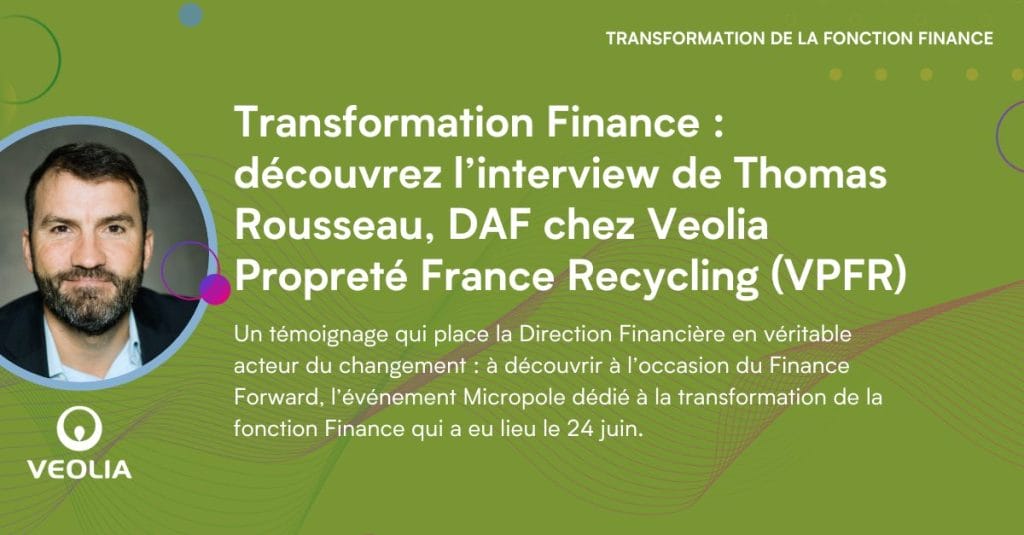
Discover the Vision of Thomas Rousseau, CFO at Veolia Propreté France Recycling
"An important notion is that of risk-taking, traditionally foreign to financial culture: we must be able to transform ourselves out of opportunity and not just out of compulsion."
Against a backdrop of increasing specialization and the growing importance of environmental issues, the finance department plays a central role in the evolution of business models.
At Veolia Propreté France Recycling, this ambition is reflected in a pragmatic transformation process structured around data. In this interview, Thomas Rousseau, the subsidiary's CFO, discusses the foundations of this transformation: advanced exploitation of data from over 80,000 shipments per year, close collaboration with the IT Department, implementation of a common repository, structuring of data governance, and development of new skills around analysis and visualization. The aim: to manage performance with precision, enhance transparency vis-à-vis customers, and transform the role of the financial department into that of a genuine strategic partner in the transformation process.
His testimony is part ofa series of interviews with finance players conducted for an exclusive study carried out in collaboration with Ifop "IA, métiers, réglementations : les priorités des fonctions finance 2025-2026" for the white paper La Finance à l'horizon 2030 : pilotage et transformation technologique.
Veolia Propreté France Recycling (VPFR) is a subsidiary ofVeolia Group, which which markets raw materials derived from waste to industrial companies for incorporation into their manufacturing processes. It incathe final stage of recycling. Although its business is based on trading, it has evolved into a company specializing in logistics and material quality analysis.material quality analysis under the leadership of its CFO, Thomas Rousseau. Interview.
Your waste recycling and recovery business has undergone significant change. What impact has this transformation had on the finance function?
We have actually transformed the way is the way our business of recovering material flows from waste is perceived. waste.
Our suppliers are aware of the value of the material they have at their disposal.nt (cardboard, plastics, metals), and our customersonly consider sourcing recycled materials if it means lower costs.
We have therefore structured our business model to position ourselves as a materials expert and not a waste "broker" speculating on prices. The end customer buys a product at the market price, plus our logistics and packaging costs. This transparency is essential to justify our prices.
This evolution required an in-depth analysis of our cost structure in order to optimize efficiency and reduce expenses.
How have you used data to drive this transformation?
Our 80,000 annual shipments generate a considerable volume of data. Drawing on my seven years' experience in Veolia's IT department, I led a major project aimed at making full use of the company's IT infrastructure. ls IT department.
We have implemented robust data collection and analysis, going beyond simple correlations of our prices with market fluctuations. Transport costsimpact of non-conformities and related services.
VPFR availablehadtonnage and cost tracking tool, it was mainly transactional and did not allow for data quality assurance or real-time analysis. Our approach was to establish a common repository, to guarantee uniformity of definitions (delivery, type of material, etc.) and to authorize access to the database on an as-needed basis.

CFOs need to get involved in IT issues, not by taking the place of the IT department, but by being able to express precise needs and evaluate potential solutions.
Did you find it easy to secure the technological investments needed for this transformation?
We have opted for pragmatic technological solutions, in particular the data visualization tools made available by the bureautical platform platform. All that remained to be done was to identify, within the IT department, the skills needed to to meet our to meet our needs. As the cost was minor, the investment was not difficult to obtain. That's what we call a "quick win".
In addition to this specific case, there is a more In addition to this specific case, there is a more global issue of responsiveness in the technological investments made by finance departments. They are perceived as cost centers, and when senior management does agree to invest, it's often on a one-off basis: we're going to change a system from top to bottom every ten years.
Yet the rapid evolution of technologies (data management optimization, ERP migration to the cloud, AI integration) demands a more agile approach. It is essential to rethink the architecture of our information systems based on a modular approach modular approach, made up of independent elements.
Specialized software (for example, for purchase to pay) rather than global solutions, making it easier to take advantage of new developments. This strategy also reduces dependence on updates from publishers, and avoids the always complex migrations of integrated systems. However, it does require the development of in-house skills in the interoperability of different modules.
How did IT and Finance divide up their roles to achieve this transformation?
When I arrived, the Data function was not structured, and the information system was attached to the Finance department. One of my first decisions was to entrust responsibility for the IS to the Information Systems department, given its expertise in infrastructure, technical administration and user support.
In addition, its role in the migration of our infrastructures to the public cloud and of our application portfolio to Saas models guarantees that our information system will evolve towards an architecture in line with the Group's policy.
The Finance Department and the IT Department work closely together in the choice of software solutions. As far as data is concerned, the finance department retains responsibility for the functional aspects (definition of roles and access, creation of a common repository, etc.). Our objective was to rapidly deploy an operational tool and to continuously improve it, favoring a quick wins approach to encourage team buy-in.
A data committee, comprising the IT, finance and sales departments, decides on the desired developments and assesses their impact.
The success of this project shows just how necessary it is for CFOs to get involved in IT issues, not by taking the place of the IT department, but by being able to express precise needs and evaluate potential solutions.
The availability of qualitative data has a positive impact on talent recruitment and retention.
What impact does this kind of transformation have on skills management?
This transformation has simplified accounting and management control processes, notably by eliminating manual data extractions.
The use of visualization tools has also improved the detection of billing errors. These productivity gains in management control have enabled us not to replace certain departures.
At the same time, we have integrated specialized skills in data collection and analysis. The role of the management controller has evolved: he now focuses on interpreting data to optimize margin monitoring.
We are now able toidentify and correct problems quickly, whereas in the past it could take several months to identify a drop in profitability and its causes. What's more, we've developed a deeper understanding of the market, enabling us to anticipate the needs of our industrial customers.
Have these financial data analyses produced operational gains beyond finance?
Our communication with customers has become clearer and more transparent. In addition, the availability of qualitative data has a positive impact on talent recruitment and retention. By accurately identifying problems (for example, a few problem deliveries out of a large number), we can also better target corrective actions and mobilize the right people to resolve them.
In the past, we tended to call on a large number of employees in an inefficient way, because we didn't know where to act.
How will the CFO's role evolve in the light of these changes?
I work closely with the head of this activity, who focuses on business issues, while I concentrate on the financial aspects of our transformation. Our information system, which is separate from that of the Group, and our very specific activity, give me a great deal of autonomy.
In general, constant adaptation to market developments and new regulations requires CFOs to have a project-oriented vision that goes beyond their usual technical skills.
Another important notion is that of risk-taking, traditionally foreign to financial culture: we need to be able to transform ourselves out of opportunity and not just out of constraint. In this respect, the arrival of AI can encourage the implementation of predictive models, by combining internal and external data (market, meteorology, etc.), for example. This could open up new perspectives for CFOs thanks to reliable forward-looking scenarios, and thus give them a far more strategic role in serving the company.
Finally, I think it's important, in a world where communication around AI is disrupting minds about the future of certain professions, for CFOs to anticipate the future of their function and the necessary evolution of their teams' skills.
Would you like to discover new testimonials? Find out about the other exclusive interviews conducted as part of the study "AI, businesses, regulations: priorities for finance functions 2025-2026".