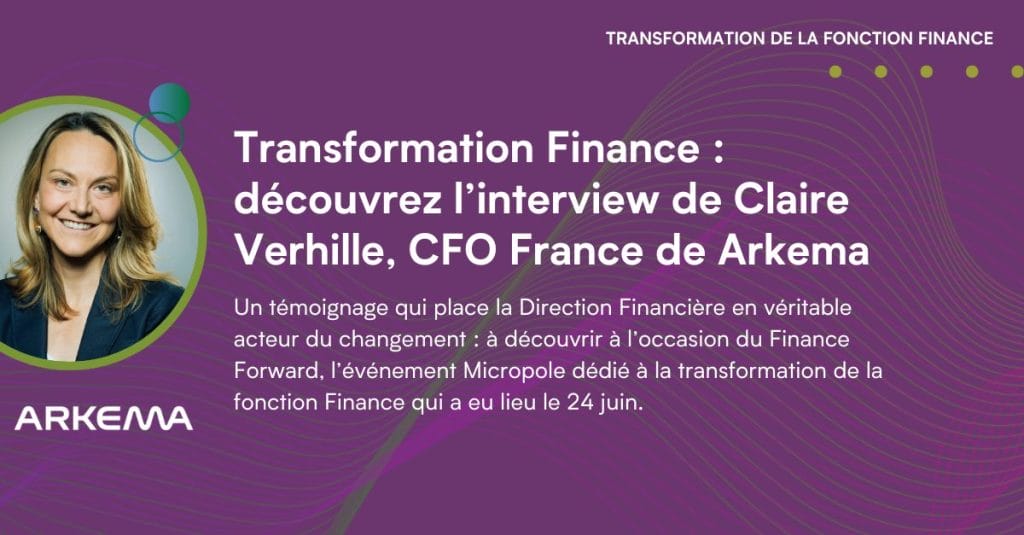
Discover the Vision of Claire Verhille, CFO France at Arkema
"The shared services and process mining model we are deploying in finance is, in my view, a model for the future that can be extended to other corporate functions."
Against a backdrop of accelerated transformation and growing regulatory pressure, Arkema's Finance Department is committed toharmonizing and standardizing its processesworldwide.
At the head of the project, Claire Verhille is piloting an international network of shared accounting services, with the ambition of going beyond transactional logic to create true centers of excellence. In this interview, she looks back at the foundations of this trajectory: advanced data exploitation via process mining, strengthened collaboration with the business lines, strategic migration to SAP S/4Hana, and the gradual rise of AI as a competitive lever.
His testimony is part ofa series of interviews with finance players conducted for an exclusive study carried out in collaboration with Ifop "IA, métiers, réglementations : les priorités des fonctions finance 2025-2026" for the white paper La Finance à l'horizon 2030 : pilotage et transformation technologique.
Arkema is now a world leader in specialty materials, employing 21,100 people in 55 countries, with sales expected to reach 9.5 billion euros in 2024. To enhance productivity and promote continuous improvement in transaction processing, Claire Verhille, CFO France and Head of Finance Shared Services for the Group, relies on a global model of operational excellence and service quality. She looks back on this ongoing "transformation journey".
One of your main missions has been to set up shared accounting services worldwide. How do they work?
Transactional activities are carried out by two "global" shared service centers, in Malaysia and France, and performance is also coordinated with local service centers, based mainly in the USA and China.
Historically, shared services have made it possible to centralize and streamline transactional operations, often in low-cost countries. But today, the rapid evolution of technology and the exponential growth of data are transforming this model.
To put it plainly, today we're dealing with an enormous amount of data, the analysis of which is a real strategic lever for value creation. The challenge is to go beyond the stage of simply executing massive transactions to become a true center of excellence capable of exploiting data to identify areas for improvement, optimize the customer experience and stimulate innovation.
In practical terms, how do these services work?
The way they operate has changed profoundly to meet the demands of an increasingly dynamic and interconnected environment.
Operational agility has become a key asset: it enables us to adjust processes rapidly to market changes and support strategic decisions with responsiveness.
Our SSCs are no longer simply processing centers; they must be perceived as trusted partners, guaranteeing reliable, measurable and customer-oriented service. This customer focus is underpinned byincreased use of digital technologies and automation, which improve efficiency, simplify operations and focus efforts on high value-added tasks.
Finally,continuous process improvement, backed by modern tools such as process mining, enables our teams to produce a tangible impact on overall company performance. This approach enables us to precisely measure and quantify sources of inefficiency. For example, we analyze the procure-to-pay (P2P) process in detail, from purchase requisition to invoice payment, in order to detect bottlenecks and friction points.
This global vision gives us the ability to intervene at any time to improve process efficiency. Our analyses can also benefit other departments, such as purchasing, by identifying avenues for optimization.
Collaboration is essential: we work closely with site managers and other corporate functions, especially procurement and supply chain, because the quality of their operations has a direct impact on our business.
In short, our approach is based on two pillars: continuous improvement, aimed at constantly optimizing our processes, and the rigorous assessment of our performance. Our objective is to carry out a monthly "service delivery review" with our internal customers, using precise indicators to measure the quality of the services we provide.

I'm convinced that AI will play a growing role in improving our competitiveness. But I believe we need to adopt a methodical approach, focusing on in-depth knowledge of our processes, close attention to their quality and maximum standardization.
What kind of profiles do you use to manage these activities?
Within our Shared Services organization, we rely on a structure of two main streams - one operational, focused on transactional processing, and the other focused on operational excellence and service quality - which reflects a strategic evolution in the role of support functions.
Each of these streams attracts profiles with distinct but complementary skills, all focused on efficiency, reliability and continuous improvement.
In centers dedicated to transaction processing (invoicing, accounts payable and receivable, expense management, etc.), we find profiles specialized in the efficient and reliable execution of high-volume standard processes. These profiles share a strong sense of detail, operational rigor and the ability to work in standardized and often multicultural environments.
At the same time, the Centers of Excellence (CoE) are attracting more analytical profiles, focused on customer service, transformation and performance management. They play an advisory, advanced standardization and innovation role. These employees are at the crossroads of technology, internal customer relations and innovation. They are proactive, focused on excellence, value creation and cross-functionality.
Do you also use artificial intelligence to optimize these processes?
Currently, most of our service providers are upgrading their platforms with AI agents based on language models or more advanced data interconnection. Ticketing tools, for example, use AI to direct queries to the most competent employees.
I'm convinced that AI will play a growing role in improving our competitiveness. But I believe we need to adopt a methodical approach, focusing on in-depth knowledge of our processes, close attention to their quality, and maximum standardization by adopting a single core model.
At the same time, changing regulations, particularly in terms of e-invoicing and CSRD, are putting increasing pressure on our ability to collect and analyze data. Our systems must enable us to obtain sufficient data granularity to produce these new reports. To achieve this, close collaboration between finance and IT departments is essential.
And this transformation goes beyond finance, as operational excellence teams also need this data to improve production processes.
The CFO will embody enlightened leadership, at the crossroads of data, technology and vision, becoming the true co-architect of the company's future.
How will these developments transform the role of the financier?
In the near future, the widespread automation of operational tasks will profoundly redefine the CFO's mission.
Freed from the constraints of execution, he will become the catalyst of an augmented finance, capable of transforming data into decision-making intelligence. His mission will no longer be limited to steering financial performance, but will extend to creating value throughout the company.
The models we're experimenting with today - shared services, centers of excellence, accompanied by tools such as process mining and process digitization - are just the beginnings of an organizational revolution. As companies adopt more global, agile and interconnected structures, tomorrow's CFO will play a central role in strategic transformation. He or she will embody enlightened leadership at the crossroads of data, technology and vision, becoming the true co-architect of the company's future.
Would you like to discover new testimonials? Find out about the other exclusive interviews conducted as part of the study "AI, businesses, regulations: priorities for finance functions 2025-2026".