Cost reduction is a recurring topic on companies' agendas, whether to improve profitability, cope with a challenging economic environment, or support transformation.
For an IT department, cost reduction efforts remain limited: technical debt requires maintaining a minimum level of investment, which cannot be delayed too often. Even by reviewing the prioritization of the project portfolio (a necessary step, whether or not there are cost reductions), reducing the CAPEX budget beyond a certain point remains complex. In practice, reducing these investments to zero can expose the company to major technical and operational risks.
The effort will therefore focus on the OPEX budget, which includes:
- The IT department's payroll
- The cost of projects carried out by external service providers
- Run costs (application and infrastructure)
- License and subscription costs, including managed services for cloud platforms (PaaS, IaaS)
- Overhead costs
Here, we focus on two approaches capable of generating sustainable or recurring cost reductions, both in terms of OPEX and CAPEX: application portfolio rationalization and industrialization.
These two levers are based on the same logic: analysis of the application portfolio and the technology portfolio.
Three steps to regain control of your wallet
The analysis of the application and technology portfolio is structured in three stages:
- Portfolio consolidation, to obtain a comprehensive overview
- The characterization of each line, application, or technology
- Analysis and benchmarking to identify concrete avenues for action
At the end of this work, two types of actions generally emerge:
- Rationalization measures: reduction and simplification of the application or technology landscape.
- Outsourcing and industrialization of build or run activities: application of productive work processes, massification, and transfer to less expensive environments (low-cost sites, industrialized services).
The key: precisely characterizing applications and technologies
In order to reach these conclusions in concrete terms, characterization is the most important step. It consists of gathering, for each application or technology, a set of information classified into several categories:
- General information and classification
- Architectural and technical characteristics
- Business characteristics
- The life cycle
- Cost data
In practice, around fifty characteristics are needed to obtain a reliable and usable overview of your portfolio. Once created, it must be regularly updated in order to provide input to the IT department's governance bodies (Design Authority, project portfolio management, etc.).
What the analysis reveals: a concrete example
To see at a glance the possibilities for exploiting such a portfolio, let's look at an example of a summary analysis:
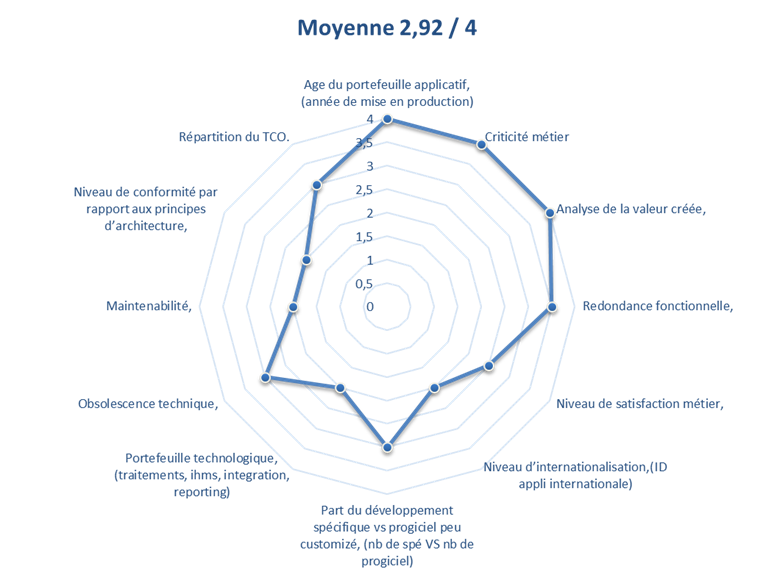
Analyzing an application portfolio can sometimes reveal surprises. In the example above, functional redundancy appears to be relatively low, making it difficult to imagine quick gains from pooling scopes. But this initial observation should not obscure the essential point: the issue must be analyzed from the perspective of business satisfaction, which is lacking in certain applications. A direct impact on the prioritization of the project portfolio should make it possible to move in both directions.
However, it is the technological aspect that attracts attention, appearing to offer high returns. The analysis highlights the proliferation of trade management solutions and various DATA-BI components, which increase implementation complexity, impact maintainability, TCO, and the risk of technical obsolescence. This is a veritable set of "time bombs," ready to explode at the slightest incident or change in architecture. This is therefore an opportunity to streamline these components, even if it will require a few projects. The savings, however, will be real and recurring.
The analysis also shows abnormally high run costs around finance solutions, exceeding the usual levels. Two actions then emerge:
- analyze the specific features integrated into these solutions
- revise the Run delivery model
This work will lead to an industrialization initiative that integrates not only incident management, but also a progressive roadmap for solution evolution, simplifying modeling to gradually bring it closer to a higher standard.
From analysis to decision
Following these various analyses, a decision file will then be structured, comparing the cost of the transformation initiatives with the expected gains according to an associated schedule.
This approach highlights one of the roles of the CIO: that of application and technology asset manager, ensuring consistency, performance, and regular cost reduction. In times when uncertainty prevents excessive investment, a drive for optimization is particularly important.

Jean-Bernard Guidt
Partner - Change & Data Strategy
Micropole, a Talan company